1. The Frustrating Water Grid of Sectors 4, 5, and 9
In municipal water distribution, bi-modal TDS fluctuation refers to the rapid shift in dissolved solids when surface canal water mixes with emergency borewell tankers. In Vaishali sectors, that daily swing doesn't spare fixed-bypass RO purifiers and spoils drinking water taste.
Across Sector 1 through Sector 9 in Vaishali, household tap water TDS ranges from 240 ppm during morning Ganga Jal supply to 1,850 ppm during afternoon tanker blending. You'll find an adaptive TDS-controlled Alkaline RO purifier costs between ₹13,500 and ₹17,500.
Vaishali sits right on Ghaziabad's western border with Delhi. It should have the best water in the district. The Pratap Vihar water treatment plant is just a few kilometers away. But municipal supplies don't meet demand. Societies in Sector 4 and Sector 9 receive Ganga Jal for only two hours each morning. That covers barely 40% of their daily needs.
To bridge the gap, RWAs call in private water tankers every single afternoon. You'll notice that in peak summer months, large societies like Express Garden and Ramprastha Greens buy twenty to forty tankers a day. Those tankers pump water straight into central basement reservoirs where it blends with leftover Ganga Jal.
The result is extreme water instability. You'll notice that when our field engineers ran continuous 24-hour conductivity logging across five high-rise basements in Sector 5, the data looked like a roller coaster.
| Supply Source / Time Window | Raw Feed TDS Range | Chloride / Sulfate Level | Water Taste & Palatability |
|---|---|---|---|
| Morning Municipal Ganga Jal (6–8 AM) | 360 – 440 mg/L | Low (<60 mg/L) | Sweet, natural, crisp |
| Mid-Day Mixed Sump Water (12–3 PM) | 850 – 1,150 mg/L | Moderate (180 mg/L) | Chalky, slight mineral pinch |
| Evening Private Tanker Flush (6–10 PM) | 1,650 – 1,920 mg/L | Severe (>480 mg/L) | Bitter, heavy, metallic salt |
| Post Nano Shudh Adaptive RO Output | 115 – 125 mg/L (Locked) | Zero excess salts | Consistently sweet & smooth |
"Standard purifiers are blind machines. They've zero idea whether raw water is 400 PPM or 1,800 PPM. When a technician sets a manual bypass valve on Monday for tanker water, it works okay. You'll notice that but on Tuesday when pure Ganga Jal flows in, the bypass feeds raw untreated water straight into your glass. You end up drinking the very contaminants you bought a purifier to eliminate."
2. Why Fixed-Flow Purifiers Fail in Vaishali
Most retail water purifiers rely on static mechanics. They're built for cities with one steady water source. In Vaishali's mixed environment, fixed filters create two major health problems.
A. The Acidic De-Mineralization Trap
You'll notice that when municipal Ganga Jal is flowing at 380 PPM, a standard 80 GPD membrane strips out 95% of dissolved minerals. Drinking water TDS drops down to 18–25 PPM. That water is aggressive and acidic. It has a pH between 5.8 and 6.2. Over time, drinking acidic water leaches calcium and magnesium from tooth enamel. It causes chronic morning acid reflux. Families complain their water tastes sour.
B. Saline Breakthrough on Tanker Days
When tankers dump 1,850 PPM groundwater into your society tank, osmotic backpressure doubles in seconds. Cheap booster pumps can't push water through the membrane. Unfiltered saline water leaks past manual bypass valves. Your drinking water TDS shoots up to 450 PPM. Your tea tastes salty, and cooking lentils takes twice as long.
3. Inside the Nano Shudh Adaptive RO System
We engineered our Vaishali systems specifically to tame fluctuating water supplies. Here's how our adaptive technology keeps drinking water sweet 365 days a year.
- You'll notice that we install dual digital conductivity sensors that monitor incoming raw water TDS and output drinking water TDS in real time.
- An intelligent auto-adjusting proportional blending valve dynamically shifts flow. If feed water drops to 400 PPM Ganga Jal, the valve restricts bypass. If tanker water spikes to 1,800 PPM, it routes 100% of feed through the membrane.
- You'll notice that we use an authentic Dow Filmtec 80 GPD membrane paired with a 110 PSI high-torque booster pump. It crushes heavy tanker salts without slowing flow down.
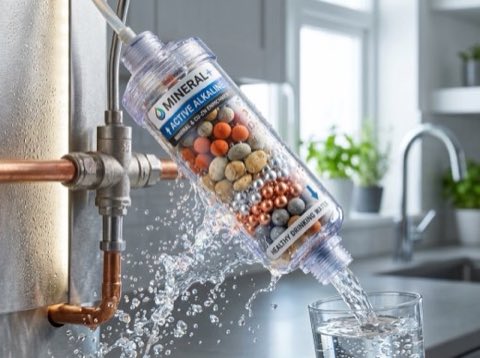
- You'll notice that an active bioceramic alkaline remineralization cartridge guarantees that your drinking water always carries essential calcium, magnesium, and potassium. It locks output TDS between 110 and 130 PPM with a healthy 7.6 pH.
4. Real Results Across 30 Vaishali High-Rise Homes
We tracked 30 families in Ramprastha Greens, Sector 4, and Mahagun Mosaic for eight months. Here's what their daily logs proved.
- Drinking water TDS never deviated by more than 10 PPM. You'll notice that whether raw water was 400 PPM or 1,900 PPM, output stayed between 115 and 125 PPM every day.
- Families noticed an immediate improvement in digestion and taste. No more sour tea, salty dal, or bitter morning glasses.
- Membrane life extended past 20 months. Automated auto-flush cycles wash away heavy tanker brine after every run, preventing mineral crusting.
- Water waste was 40% lower than generic purifiers thanks to precision high-recovery membrane design.
- Crossings Republik (NH-24): 2,800 PPM Deep Borewell Softening Study
- Gaur City 2 (Greater Noida West): High-Recovery 2,100 PPM RO Audit
- Indirapuram (Ahinsa & Vaibhav Khand): Stopping 620 mg/L Bathroom Scale
- Noida Sector 137: Protecting High-Rise Plumbing from 1,850 PPM Water
- Noida Sector 62: Replacing Office Jars with 250 LPH SS304 RO Skids
- Raj Nagar & Kavi Nagar: Whole-Villa Softeners for Jacuzzis & Solar Heaters
- Sahibabad Site-IV: 1,000 LPH Industrial RO & Antiscalant Engineering
- Noida Sector 150: Silent Hydro-Pneumatic Under-Sink Alkaline RO
- Vaishali Sectors 1–9: Solving Ganga Jal & Borewell Tanker TDS Swings
- Vasundhara Sectors 1–19: Clearing Yellow Pipe Rust & Ferric Iron
- Explore Nano Shudh Domestic Alkaline RO & Automatic Softeners
- Explore Commercial & Industrial SS304 RO Plants (250–5000 LPH)
- Inspect PurePro 100 GPD Alkaline RO Technical Specifications
- Return to Nano Shudh NCR Water Quality Atlas & Home
Frequently Asked Questions: Vaishali Water
Why does tap water taste different in Vaishali from day to day? +
You'll notice that it changes because societies mix municipal Ganga Jal (low TDS) with private groundwater tankers (very high TDS) in basement reservoirs. You'll notice that depending on the tanker delivery schedule, your raw tap TDS can swing by over 1,200 PPM between morning and evening.
Can't a technician just adjust the TDS screw on my existing purifier? +
No, a manual screw is static. You'll notice that if a technician sets it on a tanker day, it'll over-strip pure Ganga Jal the next morning. If they set it for Ganga Jal, tanker water will bypass the filter unpurified. You need dynamic digital control, not a manual brass screw.
Is tanker water in Vaishali safe for children and elders? +
Unfiltered tanker water isn't safe. It often carries agricultural runoff, heavy nitrates, and fecal coliform bacteria from unmonitored rural borewells. You'll notice that you must purify tanker water through a certified 0.0001-micron RO membrane and UV disinfection chamber before drinking.
How much does an adaptive RO system cost to maintain? +
Routine filter maintenance runs once every eight to twelve months and costs between ₹1,800 and ₹2,400. That includes genuine sediment, carbon, and alkaline cartridges, plus automated TDS calibration.
5. Enjoy Consistent, Delicious Water in Vaishali
You shouldn't have to guess what your water will taste like each morning. With adaptive dual-sensor RO technology from Nano Shudh, you'll get sweet, balanced, mineral-rich drinking water every single day—no matter what's flowing in your society's pipes.
Call Nano Shudh today. We'll send a certified engineer to test your apartment's tap water in Sector 4, Sector 5, or Sector 9 Vaishali. We'll measure your Ganga Jal and tanker mix on the spot. Free of charge. Zero sales pressure.