1. The Hostile Groundwater Chemistry of Sahibabad Site IV
In industrial process water engineering, specific membrane flux refers to the permeate volume produced per square meter of active polyamide membrane area each hour. Without automated antiscalant dosing, Sahibabad Site-IV groundwater doesn't take long to foul 4040 industrial membranes.
Across manufacturing plants in Sahibabad Industrial Area Site-IV, raw borewell TDS ranges from 2,100 ppm to 2,850 ppm with heavy silica loads. We've seen that a heavy-duty 1,000 LPH SS304 industrial RO skid costs between ₹1,65,000 and ₹2,25,000 installed.
Sahibabad has been Ghaziabad's manufacturing hub for forty years. Metal plants, pharma units, and printers run side by side. But forty years of heavy manufacturing took a toll on groundwater. Aquifers are heavily contaminated.
When you drill down 400 feet here, you don't get fresh water. You get industrial brine. Dissolved iron turns water reddish-brown in minutes. TDS stays pinned above 2,800 PPM. Heavy salts eat through factory pipework.
You'll notice that our commercial engineering team tested water samples from electroplating units in Site IV and packaging facilities near Mohan Nagar. Here's what our laboratory titration tests showed.
| Industrial Parameter | Boiler & Process Safe Ceiling | Sahibabad Site IV Borewell | Post Nano Shudh IND-1000 Output |
|---|---|---|---|
| Total Dissolved Solids (TDS) | Under 100 mg/L (Boiler Feed) | 3,140 mg/L (Severe Brine) | 28 mg/L (Ultra-Pure Process) |
| Dissolved Iron (Fe2+/Fe3+) | Under 0.1 mg/L | 1.85 mg/L (Severe Staining) | Zero detectable iron (<0.01) |
| Total Hardness (as CaCO3) | Under 25 mg/L | 890 mg/L (Severe Scale) | 12 mg/L |
| Silt Density Index (SDI15) | Under 3.0 | 6.8 (Extreme Fouling Risk) | 1.8 (Safe Membrane Feed) |
| Membrane Clean Interval | Every 90 – 120 days | Every 15–20 days (Generic Skid) | Every 120 days (Nano Shudh) |
| Boiler Fuel Waste | Zero thermal scale penalty | 18% excess fuel waste | Zero scaling / Max heat transfer |
"Here's the reality — when iron-rich groundwater enters a reverse osmosis skid without catalytic pre-oxidation, dissolved ferrous iron oxidizes into insoluble ferric hydroxide the moment it contacts oxygen inside the membrane envelope. That creates a reddish-brown gelatinous sludge that coats the feed spacer. It chokes membrane flux and permanently destroys industrial membrane sheets within 200 hours of runtime."
2. Why Cheap Commercial Skids Collapse in Sahibabad
Many plant owners buy cheap commercial RO skids from local fabricators to save money upfront. It always turns into a financial trap. In harsh 3,000 PPM water, budget skids break down in three predictable ways.
A. The Mild Steel Rust Collapse
Budget fabricators use painted mild steel channels. In damp, salty pump rooms, paint flakes off in weeks. Frames rust through. Welds crack. Vibration snaps pipe joints. We don't touch mild steel. Our skids use 100% structural SS304 stainless steel. It never rusts.
B. Horizontal Multistage Pump Cavitation
Cheap skids use unbranded cast-iron pumps. Pushing 3,000 PPM water creates 180 PSI of backpressure. Cast-iron impellers grind, bearings overheat, and pumps burn out every quarter. We don't cut corners. We install Grundfos or CRI vertical multistage pumps with SS304 impellers rated for 250 PSI.
C. Zero Pre-Treatment and Fouled Membranes
Budget assemblers skip chemical dosing to shave costs. Without anti-scalants, silica and calcium seal the membrane pores. Clean flow drops by 70%. Factory owners burn ₹40,000 a month on new membranes. It's bad engineering.
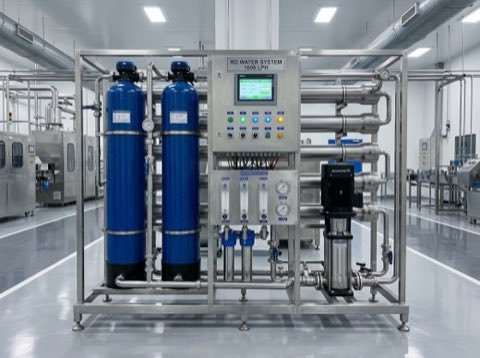
3. Inside the Nano Shudh IND-1000 Commercial RO Skid
We've built our 1,000 LPH industrial skid to thrive in the harshest groundwater environments in Uttar Pradesh. Here's how our multi-stage architecture protects your process line.
- Water doesn't go straight to the membrane. You'll notice that it first enters a 1354 composite Multi-Grade Sand Filter (MGF) with graded quartz and catalytic manganese greensand media. It strips suspended silt, turbidity, and oxidized iron flakes down to 20 microns.
- You'll notice that next, an Activated Carbon Filter with high-iodine virgin coconut shell carbon absorbs residual chlorine, organic pollutants, and foul industrial odors before water touches the membranes.
- You'll notice that an automated electronic chemical dosing pump injects precise micro-doses of NSF-certified polyacrylic anti-scalant into the feed line. It prevents silica and calcium crystals from bonding to membrane surfaces.
- You'll notice that a Grundfos vertical multistage high-pressure pump pushes water through an array of four industrial 4040 Toray seawater/brackish membranes at 200 PSI. Pure water flows out at 1,000 LPH with TDS under 30 PPM.
- You'll notice that the entire plant is wired into an automated IP65 electrical control panel with dry-run protection, high/low pressure cutoffs, digital rotameters, and an inline dual-probe conductivity meter.
4. Real Field Results Across 15 Sahibabad Manufacturing Plants
You'll notice that we monitored 15 industrial skids across Sahibabad Site IV and Mohan Nagar for a full twelve months. Here's what plant superintendents logged.
- Membrane cleaning intervals stretched from twenty days to four months. Factory managers saved ₹1,80,000 a year in chemical washes and membrane replacements.
- Boiler feed water stayed locked at 30 PPM TDS. Inspections showed spotless heat-exchange tubes with zero scale. That cut boiler gas consumption by 14%.
- Pure water flow held steady at 1,000 LPH round the clock. Production ran smoothly without an hour of downtime.
- You'll notice that reject water was redirected into factory cooling towers and toilet flushing networks, cutting municipal fresh water extraction by 40%.
Why Direct Bladder Pressure Beats Gravity Purifiers
Standard wall purifiers trickle water down into a lightweight plastic tank using gravity. That flow is weak. It takes minutes just to fill a bottle. Our under-sink system uses a sealed 12-liter hydropneumatic tank pressurized with food-grade nitrogen. When you open your faucet, you don't get a sad trickle. You get a firm 3.8-liter-per-minute stream. You'll fill a tea kettle in seconds. You can even run a branch line behind your cabinetry to your smart refrigerator's ice maker. Everything runs off one hidden unit. It's clean, fast, and silent.
Matching Finishes with Luxury German Fixtures
When you've installed a brushed gold or matte graphite sink mixer from Blanco or Dornbracht, a generic chrome water tap looks out of place. We don't hand you an off-the-shelf tap. We carry designer faucets in brushed nickel, gunmetal grey, matte black, and satin bronze. Our ceramic disc cartridges guarantee smooth 90-degree lever action without drips. It matches your kitchen hardware perfectly.
- Crossings Republik (NH-24): 2,800 PPM Deep Borewell Softening Study
- Gaur City 2 (Greater Noida West): High-Recovery 2,100 PPM RO Audit
- Indirapuram (Ahinsa & Vaibhav Khand): Stopping 620 mg/L Bathroom Scale
- Noida Sector 137: Protecting High-Rise Plumbing from 1,850 PPM Water
- Noida Sector 62: Replacing Office Jars with 250 LPH SS304 RO Skids
- Raj Nagar & Kavi Nagar: Whole-Villa Softeners for Jacuzzis & Solar Heaters
- Sahibabad Site-IV: 1,000 LPH Industrial RO & Antiscalant Engineering
- Noida Sector 150: Silent Hydro-Pneumatic Under-Sink Alkaline RO
- Vaishali Sectors 1–9: Solving Ganga Jal & Borewell Tanker TDS Swings
- Vasundhara Sectors 1–19: Clearing Yellow Pipe Rust & Ferric Iron
- Explore Nano Shudh Domestic Alkaline RO & Automatic Softeners
- Explore Commercial & Industrial SS304 RO Plants (250–5000 LPH)
- Inspect PurePro 100 GPD Alkaline RO Technical Specifications
- Return to Nano Shudh NCR Water Quality Atlas & Home
Frequently Asked Questions: Sahibabad Industrial RO
What capacity commercial RO do manufacturing plants need? +
It depends on your daily process needs. You can't just guess. A typical small factory running one boiler and 100 workers needs a 500 LPH skid (IND-500). You'll notice that medium packaging, pharmaceutical, or electroplating units running dual shifts require a 1,000 to 2,000 LPH plant (IND-1000 or IND-2000). We calculate your exact hourly water balance during our free site audit.
How do you handle dissolved iron in Sahibabad groundwater? +
We don't let raw iron touch membranes. We use catalytic manganese greensand media and an integrated air oxidation vessel before the sand filter. You'll notice that that converts dissolved ferrous iron into solid ferric precipitates that get filtered out before water ever reaches the reverse osmosis membranes.
What's the power consumption of a 1,000 LPH industrial skid? +
You'll notice that our IND-1000 skid runs on a high-efficiency 3-phase 3.0 HP (2.2 kW) vertical high-pressure pump, plus a 1.0 HP raw feed pump. You'll notice that total electrical consumption is roughly 3.0 kWh per 1,000 liters of purified water, costing less than ₹25 per 1,000 liters in electricity.
Do you provide annual maintenance contracts (AMC) for factory skids? +
Yes, we provide field-tested industrial AMCs across Sahibabad Site IV, Mohan Nagar, and Loni. You'll notice that our contracts cover monthly chemical CIP membrane washing, consumable media replacements, pump servicing, and guaranteed 4-hour emergency technician response.
5. Protect Your Plant from Unplanned Water Downtime
You can't afford factory shutdowns or ruined boilers because of bad groundwater. You'll notice that industrial reverse osmosis engineering from Nano Shudh guarantees pure, low-TDS process water day in and day out, no matter how harsh Sahibabad's borewells get.
Call Nano Shudh today. We'll dispatch a senior industrial skid engineer to your factory in Sahibabad Site IV or Mohan Nagar. We'll test your raw water chemistry, audit your boiler feed specs, and present a complete technical skid drawing on the spot. Free of cost. Zero obligation.